Why a Furnace Blows Cold Air and When It Signals Trouble
Few furnace problems are as immediately noticeable as a system that runs but blows cold or cool air instead of heat. On a cold Wasatch Front morning it is alarming, and it sends many Utah homeowners straight to the phone. Some causes are simple enough to check in a minute, while others point to a real fault that needs furnace repair. Knowing the difference helps a homeowner rule out the easy explanations, know what to tell a technician, and understand why the furnace is behaving the way it is before the house gets uncomfortable.
A furnace blowing cold air is really several different problems that share one symptom. The air coming out cold can mean the system never produced heat, that it produced heat briefly and then stopped, or that the blower is simply running when it should not be. Each of those traces back to a different part of the furnace, and walking through them in order is the clearest way to understand what is happening. The simplest checks come first, because they are the ones a homeowner can resolve without a service call.
The Simple Explanations Worth Checking First
The most common harmless cause is the thermostat fan setting. When the fan is set to ON rather than AUTO, the blower runs continuously, including during the stretches between heating cycles when it is moving room-temperature air that feels cool. Switching the fan to AUTO so it runs only when the furnace is actively heating resolves this entirely. It is worth checking first because it is both frequent and free to fix, and it accounts for a surprising share of cold-air complaints.
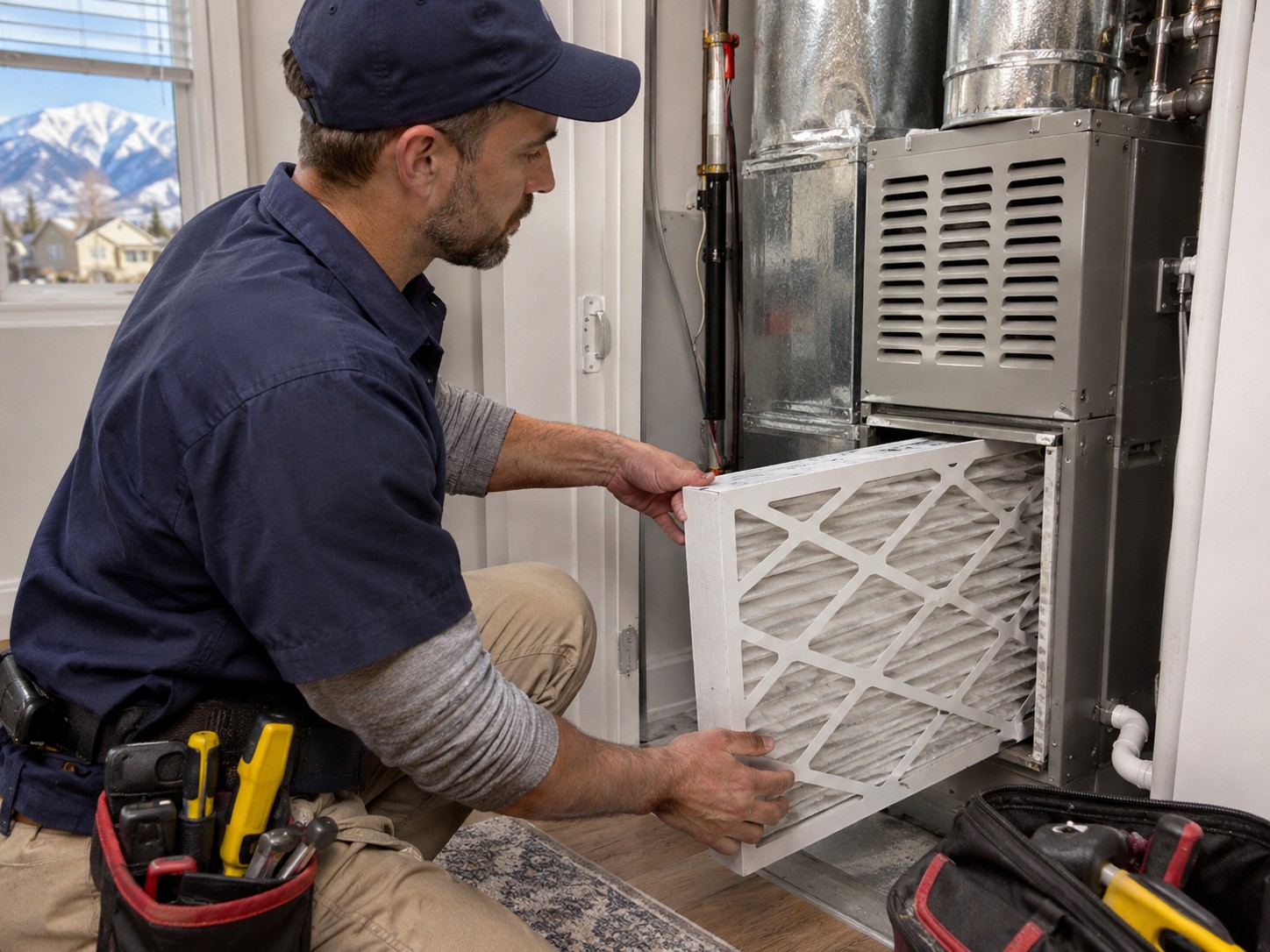
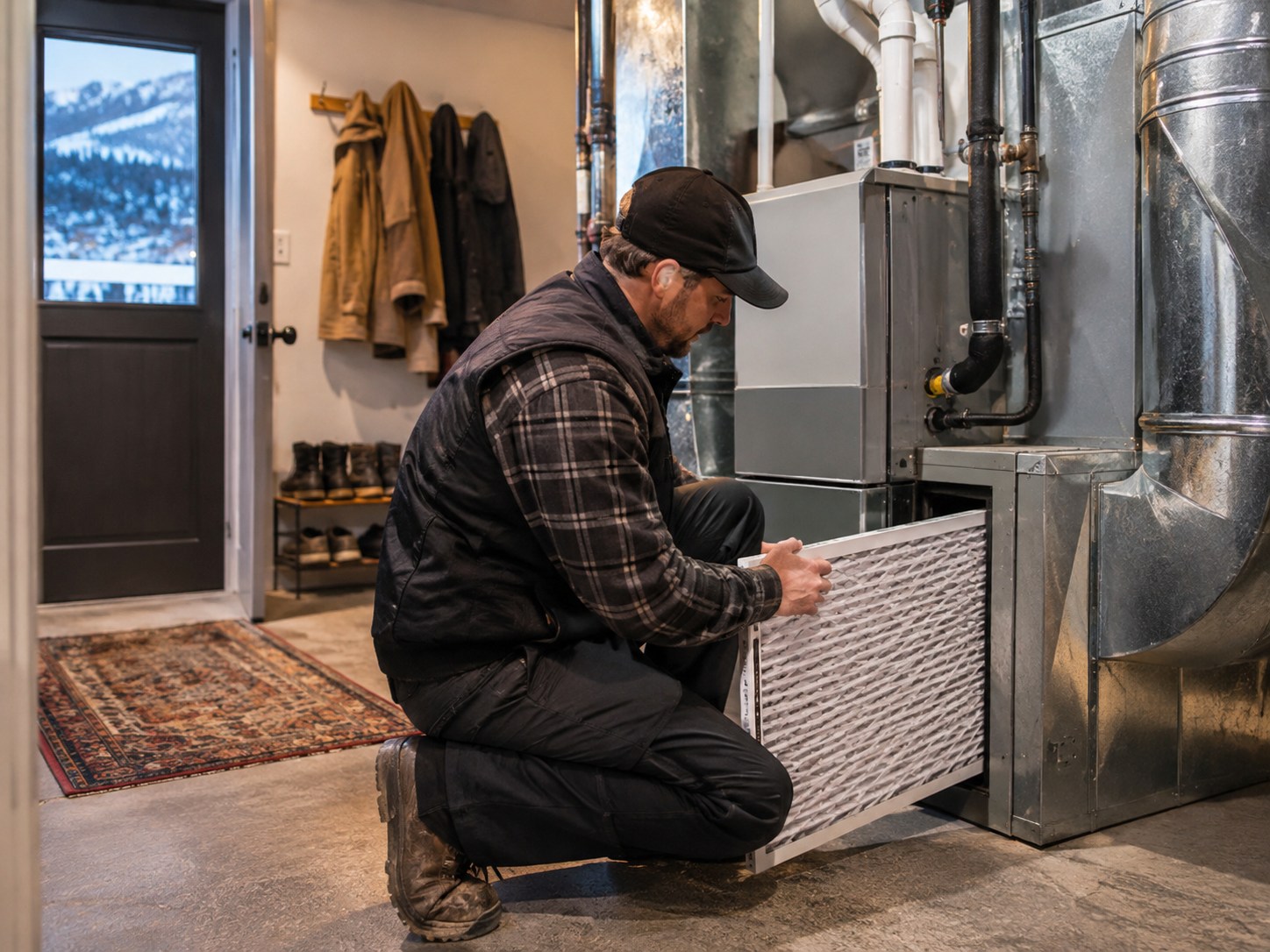
A dirty air filter is the next simple suspect. A clogged filter restricts airflow, which can cause the furnace to overheat and trip a safety device called the high-limit switch, shutting off the burners while the blower keeps running to cool the system. The result is cold air from the vents. Replacing a filter that has gone too long, something that happens easily over a long Utah heating season, often restores normal operation. If a fresh filter and the right thermostat setting do not solve it, the cause is more likely a genuine fault.
The fan setting fools many homeowners
When a thermostat fan is set to ON rather than AUTO, the blower runs all the time, including between heating cycles when it moves room-temperature air that feels cool. Switching to AUTO so the fan runs only during active heating resolves a surprising share of cold-air complaints at no cost.
Ducts lose heat in unheated spaces
Ductwork that runs through an unheated attic, crawl space, or garage, common in Utah homes, loses heat along the way, and leaks pull in cold air. The air reaching the rooms can feel cool even when the furnace is heating properly, making duct sealing and insulation part of the comfort picture.
A dirty flame sensor causes short cycling
A flame sensor coated in residue cannot confirm the flame, so the furnace lights and then shuts the gas off within seconds, often cycling on and off repeatedly. It is one of the more common furnace faults in early winter and usually among the least expensive to repair once diagnosed.
When a gas furnace tries to heat but blows cold, the issue is often in ignition. A modern furnace uses an electronic igniter rather than a standing pilot, and a failed igniter means the burners never light, so the blower pushes unheated air. A related fault involves the flame sensor, a small rod that confirms a flame is present. When the flame sensor is dirty or failing, it cannot detect the flame, so the furnace shuts the gas off as a safety measure within seconds of lighting. The system then blows cold air and may cycle on and off as it tries and fails to stay lit.
A dirty flame sensor is one of the more common and less expensive furnace repairs, since cleaning or replacing the sensor often restores reliable operation. An igniter failure is likewise a defined, fixable fault. Both are typical of a furnace that has not been serviced in a while, which is why these problems cluster in early winter when systems come back into heavy use. For an older furnace with a standing pilot, a pilot that has gone out, or a failing thermocouple that keeps shutting the gas off, produces the same cold-air result.
Overheating, Ductwork, and Other Causes
Cold air can also come from a furnace that is overheating and protecting itself. Beyond a dirty filter, restricted airflow from blocked vents or closed registers can cause the high-limit switch to cut the burners while the blower runs. If a furnace repeatedly overheats and shuts down, something is restricting airflow or the limit switch itself is faulty, and that pattern should be looked at before it stresses other components. Short cycling, where the furnace starts and stops quickly without properly heating, often shares these causes.
Less obviously, duct problems can make the air feel cold even when the furnace is heating. Ducts that run through an unheated attic, crawl space, or garage, common in Utah homes, lose heat along the way, and leaks in the ductwork pull in cold air, so the air reaching the rooms is cooler than it left the furnace. This is less a furnace fault than a distribution problem, but it produces the same complaint and is worth checking when the furnace itself seems to be working.
Thermostat fan set to ON instead of AUTO, so the blower runs between heating cycles
A clogged filter causing overheating and a safety shutoff of the burners
A failed igniter or dirty flame sensor preventing or interrupting ignition
Restricted airflow tripping the high-limit switch repeatedly
Heat loss or leaks in ducts running through unheated spaces
Running through that list explains most cases of a furnace blowing cold air. The first two a homeowner can often resolve. The ignition and airflow faults call for furnace repair, and the duct issues call for a look at the distribution system. Knowing which category a problem falls into saves time and helps a homeowner describe the symptom accurately when they call for help.
When to Call for Repair
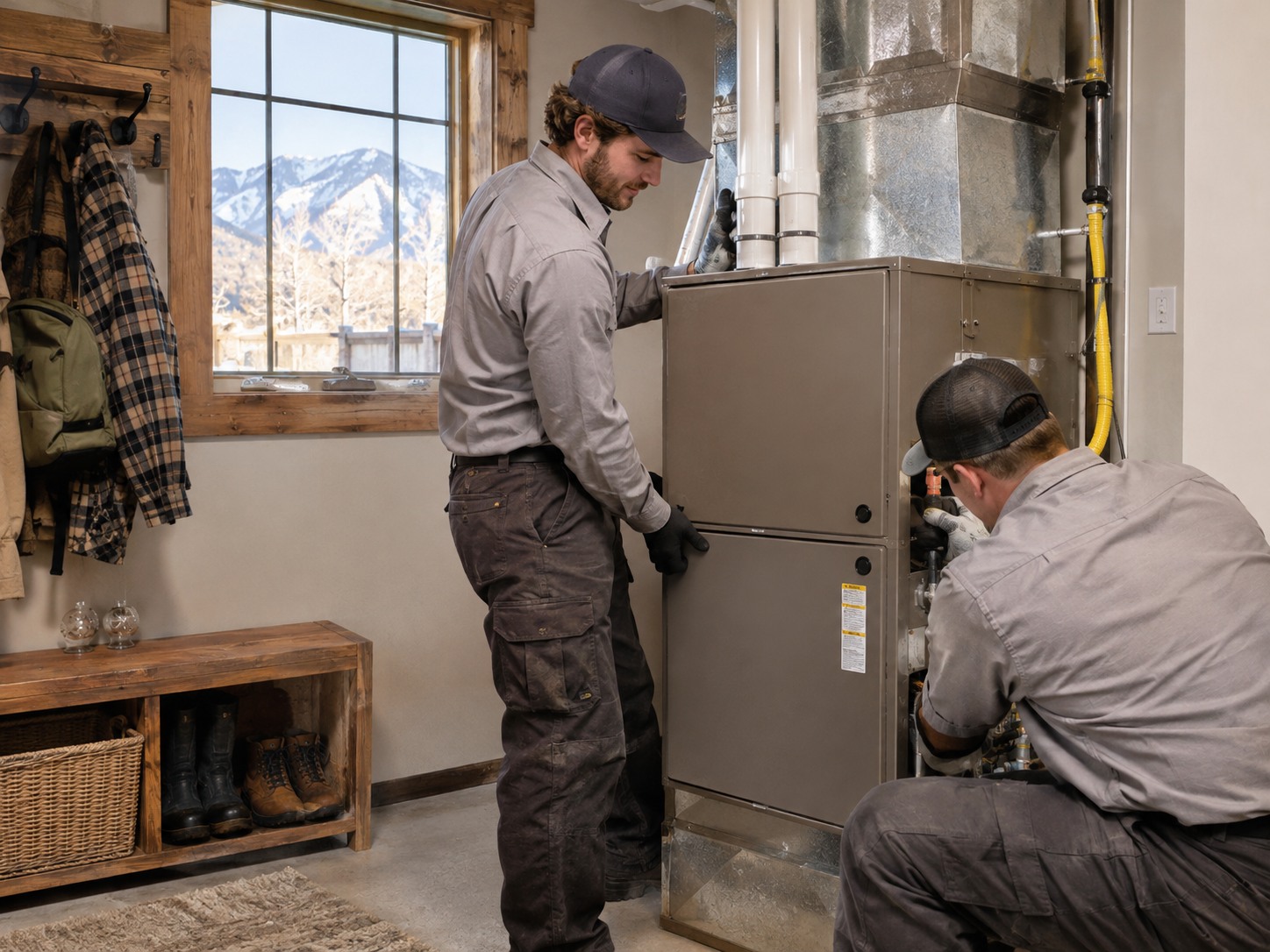
If checking the thermostat setting and replacing the filter does not restore heat, the next step is professional furnace repair rather than further do-it-yourself attempts, because ignition components, safety switches, and gas systems need proper diagnosis. It helps to tell the technician what the furnace is doing: whether it never heats, heats briefly and then blows cold, cycles on and off, or runs constantly with cool air. Those details narrow the diagnosis and often shorten the visit.
Timing matters along the Wasatch Front. A furnace blowing cold air in October is an inconvenience that can be fixed at a reasonable pace. The same fault in January, when temperatures drop and repair demand peaks, becomes an urgent no-heat problem. This is the practical argument for an annual tune-up before the season, since the flame-sensor, igniter, and airflow issues that cause most cold-air complaints are exactly what a tune-up catches and clears before they leave a family without heat on the coldest night.
When the Home Has a Heat Pump
Homes with a heat pump, including the dual-fuel systems growing more common along the Wasatch Front, can blow air that feels cool for a reason that is not a fault at all. A heat pump delivers air at a lower temperature than a gas furnace, so the air from the vents feels cooler to the hand even while it is warming the room. In a dual-fuel setup, the system runs the heat pump in milder weather and switches to the furnace in deep cold, so a homeowner feeling cooler air in the shoulder season may simply be feeling normal heat-pump operation rather than a problem needing furnace repair.
That said, a heat pump that runs constantly and never seems to warm the house, or one that blows genuinely cold air in deep cold when the furnace should have taken over, does point to a fault worth diagnosing. The switchover between heat pump and furnace is controlled by settings and sensors that can fail, and when they do, the system may lean on the wrong source for the temperature. Telling a technician that the home has a heat pump or a dual-fuel system helps them aim the diagnosis correctly rather than treating it as a standalone furnace.
Thermostats, Zoning, and Uneven Heat
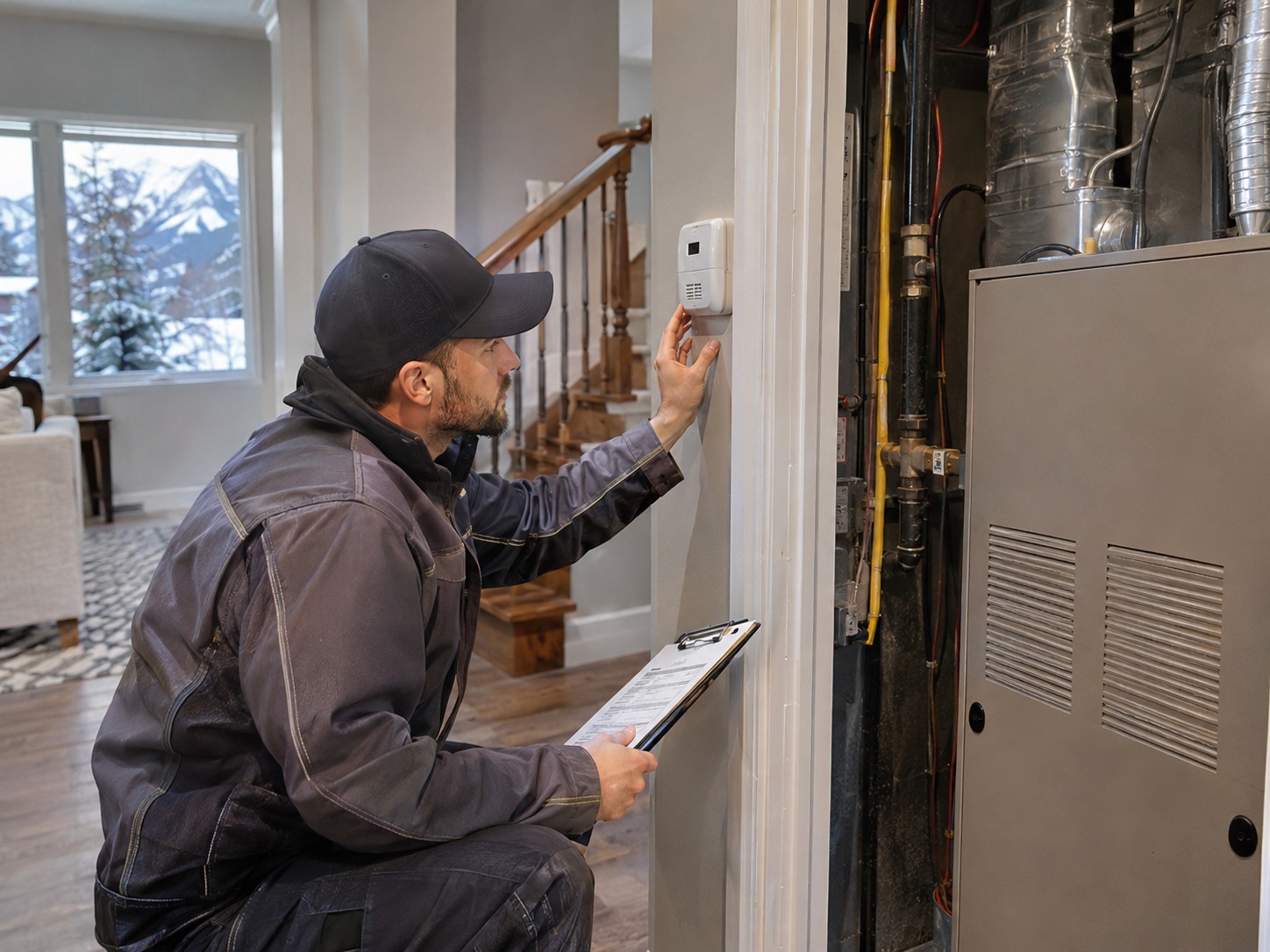
Sometimes the complaint is not cold air from every vent but cold air in part of the house, and that points toward the thermostat and the distribution rather than the furnace. A thermostat that has lost its calibration, or batteries that are failing, can make a furnace behave erratically. In a home with zoning, where dampers direct heat to different areas on separate thermostats, a stuck damper or a zone-control fault can leave one part of the house cold while another is warm. These are distribution and control problems, and a furnace repair visit often includes checking them when the furnace itself tests fine.
Uneven heat can also trace back to the ductwork, especially in Utah homes with ducts running through unheated basements, crawl spaces, or garages. Heat lost along a long duct run, or pulled out through a leak, arrives at the far rooms noticeably cooler. Sealing and insulating ducts in those unconditioned spaces is a fix that improves comfort and lowers bills without touching the furnace at all. A technician who looks at the whole system, not just the furnace cabinet, can tell a homeowner whether the cold-air complaint is a furnace fault or a distribution one.
When Cold Air Means It Is Time to Replace
Occasionally a furnace blowing cold air is a sign that the system has reached the end of its life rather than a fixable fault. A furnace near or past the twenty-year mark that repeatedly fails to light, overheats, or shuts down on its safety controls may be telling a homeowner that its major components are wearing out together. At that point, a furnace repair can restore heat for a time, but the pattern of failures tends to continue, and the cost of chasing them can approach the cost of a replacement that would run cleaner and more reliably through the Utah winter.
The judgment call rests on the furnace's age, the frequency of its faults, and the cost of keeping it running against the cost of replacing it. A younger furnace blowing cold air almost always deserves a repair. An aging one that blows cold air as the latest in a string of problems deserves an honest conversation about replacement. A homeowner who understands the causes of cold air, and who knows the age and history of their furnace, can take part in that conversation rather than simply accepting whatever is recommended.
Prevention is the quieter lesson behind most cold-air complaints. The faults that cause a furnace to blow cold, a dirty flame sensor, a worn igniter, a clogged filter tripping the limit switch, are exactly the ones an annual tune-up catches and clears before the season. A furnace serviced in early fall is far less likely to surprise a household with cold air on a freezing morning, which is the practical argument for not skipping the yearly visit.
A homeowner's own habits help too. Changing the filter on schedule prevents the overheating shutdowns that produce cold air, and keeping supply and return vents clear supports the airflow the furnace needs. A modern programmable or learning thermostat, set up correctly, can also smooth out the on-off cycling that the wide Utah temperature swings cause, which eases wear on the ignition and the blower over a long season.
When the simple checks and good habits still leave a furnace blowing cold, the fault is a genuine one that a technician should diagnose rather than a homeowner chase further. Reporting exactly what the furnace is doing, and for how long, lets the visit focus on the real cause. The goal is a system that delivers steady heat through the winter, and knowing the difference between a quick fix and a real fault is what gets a household there with less trouble.
A furnace that delivers steady, warm air all winter is the quiet goal behind all of this, and it is usually the product of a few simple habits rather than luck. Regular filter changes, the right thermostat setting, and an annual service handle most of what makes a furnace blow cold, leaving only the genuine faults for a technician to resolve.
Western Heating, Air & Plumbing provides furnace repair for homes in Lehi and across Utah County, Salt Lake County, and the Wasatch Front. A homeowner whose furnace is blowing cold air can reach the team at (385) 426-1306. More on furnace repair is available at https://westernheatingair.com/heating/furnaces/repair/.
A group of Mormon pioneers settled the area now known as Lehi in the fall of 1850 at a place called Dry Creek in the northernmost part of Utah Valley. It was renamed Evansville in 1851 after David Evans, a local bishop in the Church of Jesus Christ of Latter-day Saints. Other historical names include Sulphur Springs and Snow's Springs.[6]
The settlement grew so rapidly that, in early 1852, Bishop Evans petitioned the Utah Territorial Legislature to incorporate the settlement. Lehi City was incorporated by legislative act on February 5, 1852. It was the sixth city incorporated in Utah. The legislature also approved a request to call the new city Lehi, after a Book of Mormonprophet of the same name.[7] The first mayor of Lehi was Silas P. Barnes, from 1853 to 1854.[8]
According to the United States Census Bureau, the city has a total area of 26.7 square miles (69.1 km2) of which 26.3 square miles (68.2 km2) is land and 0.35 square miles (0.9 km2), or 1.28%, is water.[10]
As of the 2020 census, Lehi had a population of 75,907, the median age was 26.2 years, 39.5% of residents were under the age of 18, and 5.8% of residents were 65 years of age or older. For every 100 females there were 101.5 males, and for every 100 females age 18 and over there were 99.1 males age 18 and over.[15] There were 20,296 households in Lehi, of which 58.1% had children under the age of 18 living in them. Of all households, 73.3% were married-couple households, 10.4% were households with a male householder and no spouse or partner present, and 13.8% were households with a female householder and no spouse or partner present. About 11.1% of all households were made up of individuals and 3.4% had someone living alone who was 65 years of age or older.[15] There were 20,994 housing units, of which 3.3% were vacant. The homeowner vacancy rate was 1.1% and the rental vacancy rate was 4.2%.[15] 98.3% of residents lived in urban areas, while 1.7% lived in rural areas.[16]
As of the American Community Survey (ACS) Demographic and Housing Estimates of 2023,[17] there were 90,229 people living in the city. The estimated racial makeup of the city was 81.7% European American, 0.5% African American, 0.2% Native American, 2.0% Asian, 1.5% Pacific Islander, 2.0% from other races, and 12.1% from two or more races. Hispanic or Latino of any race were 12.1% of the population. An estimated 50.2% of the population was male with 49.8% female. The median age as of 2023 was 26.6.
According to the 2010 Census,[18] there were 12,402 households, out of which 61.0% had children under the age of 18 living with them, 78.4% were husband-wife families living together, 3.2% had a male householder with no wife present, 7.1% had a female householder with no husband present, and 11.3% were non-families. 9.0% of all households were made up of individuals (living alone) and 11.7% had someone living alone who was 65 years of age or older. The average household size was 3.81 and the average family size was 4.08.
As of 2018, the median income for a household in Lehi was $74,200, and the median income for a family was $88,278. The per capita income for the city was $25,894, including all adults and children. The unemployment rate for Lehi was 3.0%. The job growth rate was at 2.6% and was expected to grow 54.8% over the next 10 years.[19]
Lehi has been transitioning from an agricultural economy to a technological economy. This first started with the lengthy construction of a DRAM microchip plant by Micron Technology, which eventually evolved into a NAND flash memory business called IM Flash Technologies that was founded by both Micron and the Intel Corporation with headquarters in Lehi. In 2013, 1 out of every 14 flash memory chips in the world was produced in Lehi.[20] On June 30, 2021, Texas Instruments announced that they would be purchasing this facility.[21]
Adobe Systems based one of its U.S. buildings in Lehi, which is home to about 900 employees. According to the Adobe website, "The team in Utah is focused on engineering, product development, sales, marketing, and operations for the industry-leading Adobe Marketing Cloud."
IASIS Healthcare built Lehi's first hospital, which opened in June 2015. The company broke ground for the medical center in February 2014. The 23-acre campus houses a 40-bed, full-service facility with an emergency department, intensive care unit, medical imaging, cardiac lab, surgical suites, and labor and delivery.[22]
Vivint operates a five-story office building in Lehi where the majority of its engineering work takes place.[citation needed]
Ancestry.com moved its headquarters from Provo to Lehi in May 2016. The headquarters building is located in The Corporate Center at Traverse Mountain. Its competitor MyHeritage also has an office in Lehi.[citation needed]
Microsoft has an engineering department specializing in the next version of its MDOP (Microsoft Desktop Optimization Pack), code-named "Park City."[23] Initially employing 100, Microsoft has built a second building to house its staff.[24][25]
Lehi Roller Mills was featured in the movie Footloose (1984).
Lehi Roller Mills was founded in 1906 by a co-op of farmers. George G. Robinson purchased the mill in 1910, and it has since remained in the Robinson family, currently run by George's grandson, R. Sherman Robinson. The mill produces some 100,000 pounds of flour each day.[29]
The turkey and peacock flour paintings of Lehi Roller Mills were painted on the silos about 1930 by Stan Russon of Lehi, Utah. He used a rope and pulley system to manually raise and lower himself to be able to paint.[citation needed]
Lehi Roller Mills was featured in the movie Footloose (1984) as Ren McCormack's workplace and as the site of the dance. At the time the film was made, Lehi Roller Mills was surrounded by nothing but vacant fields. In one scene, the Reverend Shaw Moore and his wife Vi Moore keep a wary eye on the proceedings while standing in a field some distance away. The area is now home to a variety of fast food restaurants and a shopping center.[30]
Thanksgiving Point is a nonprofit museum complex and estate garden founded in 1995. It consists of six main attractions: the Ashton Gardens, Thanksgiving Point Golf Course, the Museum of Ancient Life, the Museum of Natural Curiosity, Farm Country, and the Butterfly Biosphere.[34] Approximately 1.45 million people visit Thanksgiving Point each year. It is also a location for Megaplex Theaters and has several restaurants and gift shops. It is the site for the region's only Tulip Festival, an annual Scottish Festival, annual Cornbelly's Halloween attraction,[35] and Highland Games.
The complex is a 501(c)(3) organization with operations funded by private donations, venue and event admissions, and profits from shops and restaurants.[36]
The Veterans Memorial Building currently houses Hutchings Museum.
The Hutchings Museum is a museum located near the center of Lehi. It was first established in 1955 in what is now the Lehi Arts Building. The museum later moved its current location in the Veteran Memorial Building at 55 N Center St, Lehi, UT. The collection was donated to the city by John and Eunice Hutchings, who were amateur collectors and naturalists.[citation needed]
Originally designed to be a memorial for the veterans in World War I, the Veteran Memorial Building later expanded to host a library, courthouse, jail, police station, and fire station, among others.[37]
The Hutchings Museum's exhibits include a large range of displays and artifacts featuring Native American culture, geology and paleontology, ornithology, live animals, and both local city and regional history.[38]
Some of the Museum's most notable artifacts include a gun that reportedly belonged to Butch Cassidy, a large collection of rocks and minerals, and several pieces of Native American pottery.[39] The museum has online articles, photos, videos, 3-D scans of artifacts, and a virtual tour.[39]
Mountainland Technical College (MTECH) is a public technical training institution located in Lehi that serves high school seniors (through dual enrollment) and adult students. The Lehi campus offers training and education in automotive, culinary arts, healthcare, information technology, and a growing number of other industry-specific programs. It also partners with many area employers to provide customized training for their employees through the Custom Fit program.[42]
Challenger School, a private school system with 27 campuses in the United States—six of them on the Wasatch Front—operates a school in the Traverse Mountain area of Lehi that serves preschool through eighth grade.[43]
I-15 runs through Lehi, with five exits (at American Fork Main St/SR-145, Lehi Main St/SR-73, 2100 North/SR-194, Triumph Blvd, and Timpanogos Highway/SR-92) located in the city.[44] The Utah Transit Authority operates a bus system that reaches into the city. Work on the FrontRunner Southcommuter rail began in August 2008, and the Lehi station opened for service on December 12, 2012.[45] The Lehi station is located near Thanksgiving Point.
^Lehi City Corporation. Memories of Wilford Brimley. Lehi, UT: Lehi City, 2013. https://www.lehi-ut.gov/wp-content/uploads/2013/12/MemoriesofWilfordBrimley.pdf
Lehi Centennial Committee (1950), Lehi Centennial History, 1850-1950; A History of Lehi for One Hundred Years, Lehi, Utah: Free Press Publishing Company.
Lehi Historical Preservation Commission (1997), A Guide to Lehi City's Historical Sites and Places, Lehi, Utahcitation: CS1 maint: location missing publisher (link).
Mellor, Carl J. (1995), Historic Lehi: Pony Express Trail, Stagecoach Route, United States/Mormon War, Porter Rockwell, Lehi, Utah: Lehi Chamber of Commerce.
No. Professional leak detection is designed to locate the leak without tearing the home apart. Acoustic listening, thermal imaging, and pressure testing pinpoint the source first, so the repair opens only the spot where the leak actually is rather than exploring walls, floors, or the yard hopefully. That precision protects the home and lowers the repair cost.
Can a dirty filter make a furnace blow cold air?
Cost depends on the leak's location and how much work the detection requires, so a firm number comes after the technician sees the situation rather than over the phone. Western presents upfront written pricing before any work begins, so you approve the cost in advance. Finding the leak early almost always costs far less than the water damage a hidden leak causes.
What is a flame sensor and why does it matter?
Ask for a free written estimate after a diagnostic visit, with detection and repair quoted separately. Ask what tools will be used and why, whether the work carries a warranty, and what happens if the first suspected source is wrong. A reputable Salt Lake City plumber answers these plainly; vague replies or on-the-spot pressure are a cue to compare.